Groundwater pressure is one of the most important inputs in geotechnical design. It controls the strength of soils, the stability of slopes and excavations, uplift on basements and the need for dewatering. Water strikes noted during drilling are rarely reliable, especially when drilling fluids are used. The standard way to measure groundwater properly is to install a standpipe piezometer. This article explains how to install one correctly.
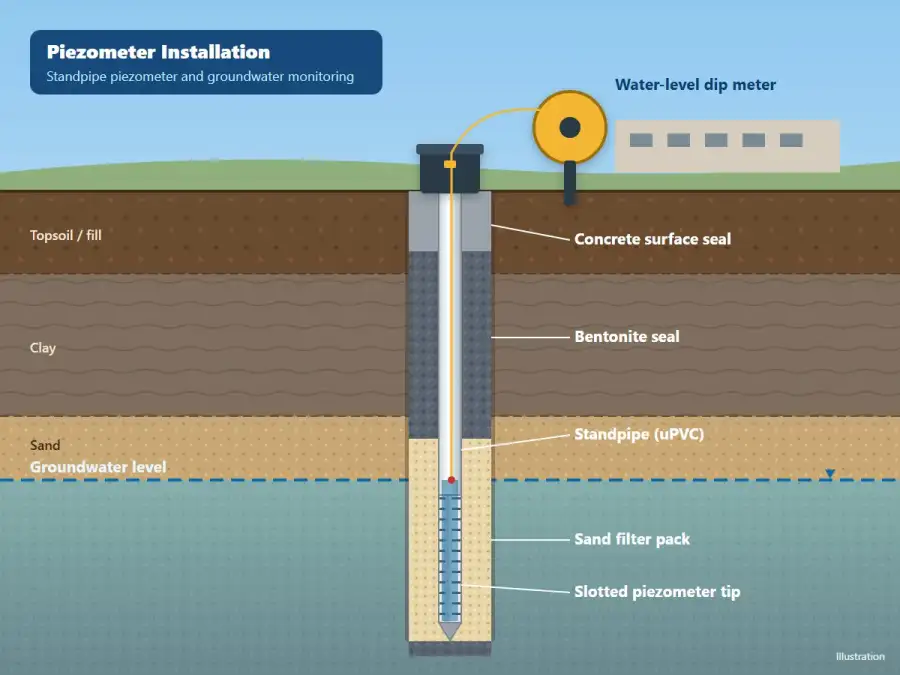
Components
| Component | Purpose |
|---|---|
| Slotted pipe (response zone) | Lets water enter from the layer being monitored |
| Plain riser pipe | Carries the water level to the surface for reading |
| End cap | Closes the bottom of the pipe |
| Geotextile sock (optional) | Reduces fines entering the slots |
| Filter sand | Surrounds the response zone, allows water to flow to the pipe |
| Bentonite seals | Isolate the response zone from layers above and below |
| Grout backfill | Fills the remaining annulus |
| Headworks | Protective cover, lockable cap and concrete surround |
Pipes are typically uPVC or HDPE with an internal diameter of around 19 to 50 mm, large enough for a dip meter or small logger.
Plan the response zone first
A piezometer measures pressure in one layer, so the engineer must decide which layer matters: the aquifer under a basement, the clay behind a slope, the sand at foundation level. A single long slotted section across several layers gives a mixed reading that represents none of them. Where two layers matter, install two separate piezometers or a nested installation with good seals between them.
Installation step by step
- Drill and log the borehole to the planned depth. Record the stratigraphy carefully so the response zone is placed in the right layer. See core logging and soil description.
- Clean the borehole. Flush out drilling fluid and cuttings with clean water where possible. Mud left in the borehole slows response and can seal the response zone. See drilling fluids and bentonite.
- Backfill below the response zone if the borehole is deeper than needed, using bentonite pellets or grout, so the zone is isolated from below.
- Place a base layer of filter sand, typically 0.3 to 0.5 m.
- Lower the pipe with the slotted section centred on the target layer. Use centralisers in larger boreholes.
- Add filter sand slowly around the slotted section, tamping or measuring the level as you go, to about 0.3 to 0.5 m above the slots.
- Place the bentonite seal above the sand, usually pellets or chips of at least 0.5 to 1 m. In dry boreholes, add water in stages so the bentonite hydrates.
- Grout the remaining annulus with a cement-bentonite grout, or alternate seals as specified.
- Install headworks: cut the pipe to height, fit a vented cap, install a lockable protective cover set in concrete and label it clearly.
- Measure and record all depths during installation: base of borehole, sand, slots, seals and grout. Make an installation diagram for the report.
Development
After installation, the piezometer is developed by pumping, bailing or surging, to remove fines and drilling fluid from the response zone so it responds properly to groundwater. For a simple test of response, add or remove a known volume of water and watch the level recover.
Taking readings
- Use a calibrated dip meter, measuring from a marked datum on the pipe top.
- Record date, time, depth to water, pipe top level and weather.
- Take several readings over days or weeks, especially in clays, to see the level settle.
- Continue monitoring through wet and dry seasons where design depends on maximum water levels.
- For frequent readings, install a data logger.
Our article on groundwater monitoring during geotechnical investigations explains how readings are used in design.
Common mistakes
| Mistake | Consequence |
|---|---|
| Slotted section across several layers | Mixed reading that misrepresents the pressure in each layer |
| No bentonite seal or a seal that did not hydrate | Surface water or other layers short-circuit the reading |
| Drilling mud left in the hole | Slow or no response |
| Bridging of sand or pellets | Voids and incomplete seals |
| No protective cover | Damaged or blocked pipe; lost data |
| One reading only | Level not stabilised; seasonal changes missed |
When to use vibrating wire piezometers
In low permeability clays, a standpipe may take weeks to respond. Vibrating wire piezometers measure pressure directly with almost no water flow, so they respond quickly and can be read remotely. They are common in dams, embankments, deep excavations and slope monitoring.
How Quantum Geoconsultants can help
Our crews install and monitor standpipe and vibrating wire piezometers as part of geotechnical surveys in Kenya and Somalia, with full installation records.
Frequently asked questions
What is a standpipe piezometer?
A small-diameter pipe with a slotted section at the bottom, installed in a borehole and surrounded by filter sand, with bentonite seals above. It measures the groundwater pressure at that response zone.
How long after installation can piezometer readings be trusted?
After the piezometer has been developed and the water level has stabilised. In permeable soils this may be hours or days; in clays it can take weeks, so several readings over time are needed.
What is the difference between a standpipe and a vibrating wire piezometer?
A standpipe is read manually with a dip meter and is simple and robust. A vibrating wire piezometer is an electronic sensor that responds quickly, works in low permeability ground and can be logged automatically.
🏗️ Request a geotechnical survey quote
The scope and cost of a geotechnical investigation depend on the size and type of structure, the site area and the ground conditions. Tell us about your project and we will propose an investigation programme and quotation.
Under the National Building Code 2024, soil testing is now expected before construction. We reply with a proposed programme and quotation.
Book a geotechnical survey in Kenya
Know your ground before you build. Send us your site location and project details and we will propose an investigation programme and quotation.