A specification might say “compact to 95% of maximum dry density”. The laboratory compaction test gives the maximum dry density. But how do you know whether each layer on site actually reached 95%? That is the job of field density testing. This article explains the main methods and how to use the results.
What is measured
- Bulk (wet) density: mass of soil and water per unit volume.
- Moisture content: mass of water as a percentage of dry soil.
- Dry density = bulk density ÷ (1 + moisture content).
- Relative compaction = field dry density ÷ laboratory maximum dry density × 100%.
Moisture content is also compared with the optimum moisture content to check that fill was placed within the specified range.
Sand replacement method
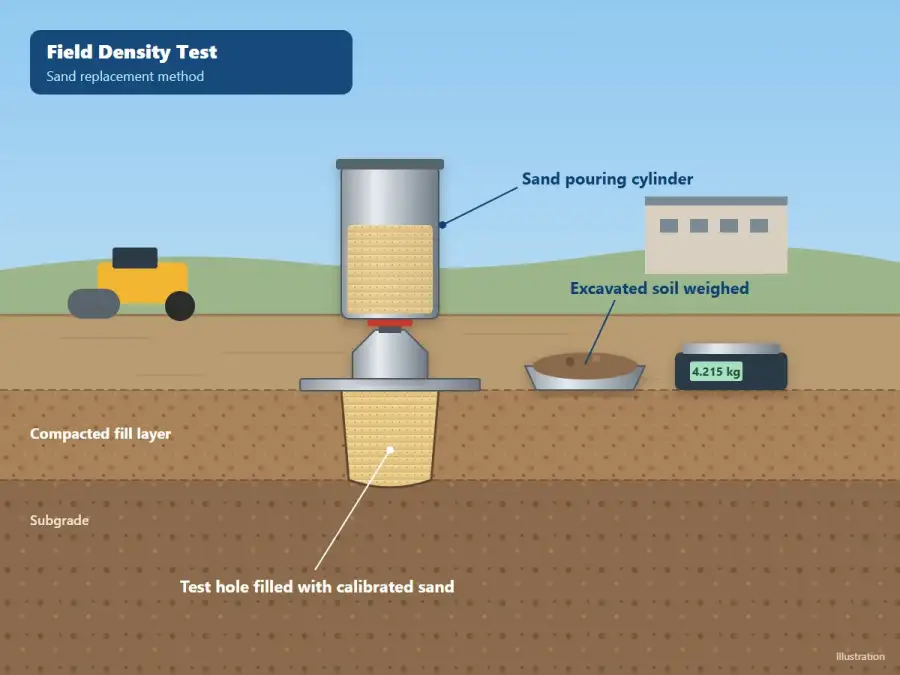
This is the classic reference method, standardised in BS 1377-9 and similar standards.
Procedure
- Level the surface of the compacted layer.
- Dig a hole of standard size through the layer, collecting all excavated soil in a sealed container.
- Weigh the excavated soil and take a sample for moisture content.
- Pour calibrated, uniform dry sand from a pouring cylinder into the hole.
- From the mass of sand used and its known density, calculate the volume of the hole.
- Bulk density = mass of soil ÷ volume of hole.
Strengths and limits
- Direct measurement, no radiation, inexpensive equipment.
- Slow: each test takes time, and moisture results wait for oven drying.
- Requires careful calibration of the sand and cone, and protection from vibration during pouring.
- Less suitable for very coarse materials, where larger apparatus is needed.
Core cutter method
A steel cylinder of known volume is driven into soft, cohesive soil, dug out and weighed. It is quick and simple but only suited to fine soils without stones.
Nuclear density gauge
A nuclear gauge uses a small radioactive source to measure density (by gamma radiation) and moisture (by neutron moderation).
Strengths
- Results in a few minutes, so many tests can be done each day.
- Non-destructive in backscatter mode; direct transmission uses a small hole for the probe.
- Immediate feedback lets contractors rework failing areas before placing the next layer.
Limitations
- Requires licensed operators, radiation safety procedures, secure storage and transport permits.
- Moisture readings can be affected by materials containing hydrogen or certain minerals, such as some clays, gypsum and organic soils.
- Should be calibrated against sand replacement tests on the project materials.
Other methods
- Water replacement and large-scale sand replacement for rockfill and coarse materials.
- Electrical density gauges as non-nuclear alternatives, with material-specific calibration.
- Proof rolling and DCP as quick checks for soft spots, not substitutes for density tests.
Worked example
A sand replacement test on a subbase layer gives a bulk density of 2.18 Mg/m³ and a moisture content of 7.5%. Dry density = 2.18 ÷ 1.075 = 2.03 Mg/m³. The laboratory MDD (modified Proctor) is 2.10 Mg/m³. Relative compaction = 2.03 ÷ 2.10 = 96.7%. If the specification requires at least 95%, the layer passes.
Test frequency and location
- Follow the specification for tests per layer, area or volume.
- Spread tests across the layer, including edges and areas near structures where compaction is harder.
- Test each layer before the next is placed.
- Retest after reworking failed areas.
- Use the correct MDD: if the material changes, a new compaction test is needed.
Common errors
| Error | Effect |
|---|---|
| Comparing with the wrong MDD | False pass or fail |
| Hole not through the full layer depth | Misses poorly compacted lower part |
| Vibration from plant during sand pouring | Sand compacts, volume over-estimated |
| Soil lost from the hole | Density under-estimated |
| Uncalibrated nuclear gauge | Systematic bias in density or moisture |
How Quantum Geoconsultants can help
We carry out laboratory compaction tests and field density control for roads, platforms, foundations and embankments. See our geotechnical services in Kenya and our guide to CBR testing.
Frequently asked questions
What is a field density test?
A test that measures the in-place density and moisture content of a compacted soil layer, so it can be compared with the laboratory maximum dry density to check whether compaction meets the specification.
Which is more accurate, sand replacement or nuclear gauge?
Sand replacement is a direct reference method and is very reliable when done carefully. Nuclear gauges are much faster and give good results when calibrated against sand replacement on the same material.
How often should field density tests be done?
Specifications set the frequency, typically a number of tests per layer, per area or per volume of fill placed. More tests are needed when materials or compaction methods change.
🏗️ Request a geotechnical survey quote
The scope and cost of a geotechnical investigation depend on the size and type of structure, the site area and the ground conditions. Tell us about your project and we will propose an investigation programme and quotation.
Under the National Building Code 2024, soil testing is now expected before construction. We reply with a proposed programme and quotation.
Book a geotechnical survey in Kenya
Know your ground before you build. Send us your site location and project details and we will propose an investigation programme and quotation.